


When a clinical research platform needed to serve an entirely new set of users — sponsors and CROs alongside existing research sites — the existing architecture couldn't keep up. I led the redesign from the ground up using the OOUX framework, reimagining how documents, processes, and compliance requirements connect across a system serving multiple organization types. The approach resonated so strongly with leadership it became the company's top priority.

Revolutionizing Clinical Research Management
Clinical research sites manage some of the most complex, high-stakes workflows in healthcare — documents, compliance requirements, study timelines, and participant data all converging in one system. The platform I worked on was originally built for research sites, and it did that job well. But as the business grew, sponsors and CROs came onto the platform, bringing entirely new use cases and requirements the existing system wasn't designed to handle.
Expanding User Base
What began as a site-focused tool now needed to serve three distinct organization types with different roles, permissions, workflows, and mental models. The complexity multiplied quickly — what worked for one user type created friction for another.
Meeting Growing Demands
As clinical research evolved, users needed more than document storage. They demanded intelligent workflows and rich data insights. The existing architecture had fundamental limitations that couldn't support where the product needed to go. A complete reimagining was the only path forward.
While the design strategy appeared straightforward, executing simplicity at scale proved to be complex.
The new site enablement platform aimed to:
• Mirror real-world concepts and terms
• Support diverse organizational scenarios
• Balance structure with flexibility
• Ensure intuitive usability
• Provide built-in insights
• Simplify setup and configuration
• Streamline roles and permissions
• Enable workflow personalizationImplement Universal Design principles
The task of innovating and replacing an entire suite of clinical research products presented both excitement and significant challenges. Our team recognized the importance of establishing a solid foundation while maintaining the flexibility to reassess and adjust priorities throughout the development process.
As lead designer, I spearheaded a comprehensive analysis of our flagship electronic document management tool. My investigation revealed fundamental limitations in the existing architecture that couldn't support our evolving user needs.I leveraged the OOUX (Object-Oriented UX) framework to reimagine the system's foundation, collaborating closely with product, innovation, and technology teams. This strategic approach to solving core structural problems resonated so strongly that it became the company's top priority.
We began by crafting a comprehensive object model to define the system's core structure. Through extensive collaboration with stakeholders and subject matter experts, we mapped out the fundamental building blocks that would support our evolving platform.

The high-level system architecture illustrates how the platform operates across three key levels: Internal System, Organization System, and Study Lifecycle. This layered approach shows how we support everything from user management to study execution — from initiation through completion. The design accommodates the full range of workflows, including study setup, active management, and archival processes.

Our model went beyond basic relationships — we designed a system where data flows intelligently between objects, automating repetitive tasks and streamlining workflows for users.

Each object contains carefully defined attributes that enable:
• Intuitive navigation between connected elements
• Simplified user permissions
• Automated data exchange
• Enhanced workflow efficiency

I created conceptual designs to align leadership vision and facilitate cross-functional communication. These designs focused on two core components:
Organization Profile

Study List Page

Understanding how users move through the system was crucial. I developed a comprehensive navigation flow ensuring users could efficiently access any part of the system, regardless of their starting point.
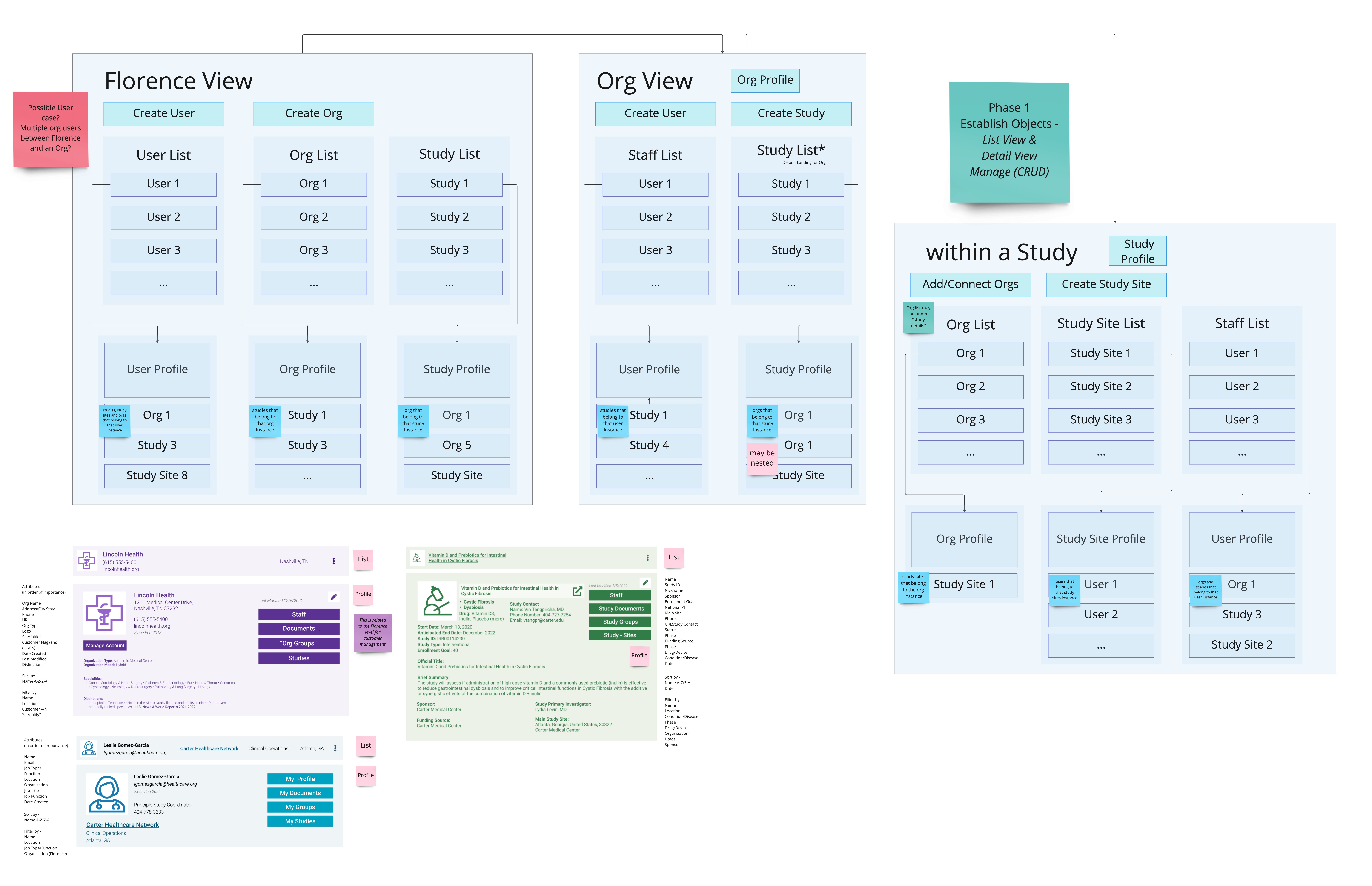
Working closely with the product lead, I developed two critical frameworks:
A detailed mapping of attributes that define each object, creating a foundation for Phase 1 implementation. This modular structure allows for future system evolution and enhancement.

A comprehensive list of object actions that defined what users could do throughout the system. This framework was essential for prioritizing features and determining access levels, as it captured all potential user privileges across the platform.

The path forward includes continuing user feedback sessions and coordinating change management strategies. We're planning subsequent phases to expand beyond initial priorities while supporting development teams in implementing the concept and strategy.
